PDF Statistics 2026: 16 Key Numbers
On-device OCR. Secure, built for iOS.
PDF Statistics 2026: 16 Key Numbers
Adobe Acrobat alone accounts for 400 billion PDF opens per year, and over 290 billion new PDFs are created annually worldwide, growing 12% year over year. The PDF software market is valued at $2.68 billion in 2026 and is on track to reach $7.13 billion by 2035. On the device side, 63% of PDF views now happen on smartphones and tablets, yet 33% of scanned PDFs remain unsearchable because OCR was never applied. The mobile scanner apps market is growing at 18.62% annually, signaling that scanning paper into files you can search on the phone you already carry is no longer a niche workflow - it is the default. These 16 statistics map where PDF stands in 2026 and why mobile scanning sits at the center of it.
PDF is 30 years old and more entrenched than ever. The format became an ISO standard in 2008, and today it underpins contracts, invoices, tax filings, medical records, and academic publications across every sector. As explored in our document management statistics, organizations are accelerating the shift to digital filing, and PDF is the format that receives that flood of scanned paper.
This post covers PDF volume, market size, mobile usage, OCR adoption, scanning market growth, and the cost of poorly managed documents. It is written for freelancers, small-business owners, field professionals, and anyone deciding how to handle the paper that still flows through their work. Below are 16 statistics that define the PDF landscape in 2026.
1. Adobe Acrobat opens 400 billion PDFs per year
Adobe Acrobat handles 400 billion PDF opens and 16 billion file edits annually, according to Adobe's own reported figures. Adobe Document Cloud, the broader suite that includes Acrobat and Acrobat Sign, generated $3.18 billion in revenue in fiscal year 2024 - an 18% year-over-year increase. No other file format comes close to this scale of daily use. The 400-billion-opens figure reflects PDFs landing in every corner of modern work: tax forms, purchase orders, signed agreements, research papers, and the scanned receipts piling up in accounting folders. Adobe's sustained revenue growth in the document segment confirms that demand for PDF tooling is expanding, not plateauing. The format's universality - it renders identically on every device and OS - is the underlying reason it has outlasted rivals.
Source: Adobe - Q4 and FY2024 Earnings Release
2. Over 290 billion new PDFs are created each year, growing 12% YoY
More than 2.5 trillion PDFs exist worldwide, with 290+ billion new ones added annually at a 12% year-over-year growth rate, according to data compiled by Smallpdf. To put that in perspective: roughly 9,200 new PDFs are created every second of every day. The growth rate outpaces most legacy document formats because PDF hits the right balance between compatibility, compression, and fidelity. It preserves fonts, images, and layout regardless of the software used to open it, which is why contracts, invoices, and official correspondence default to it. That volume also means search and retrieval become real problems at scale. A business that cannot search inside its PDFs is effectively managing a filing cabinet - just a digital one.
Source: Smallpdf - PDF Statistics & Usage in 2025
3. 98% of businesses use PDF as their default format for external documents
Ninety-eight percent of businesses use PDF as their default file type for external communication, according to research cited by Smallpdf. A separate figure from multiple industry sources puts the share of enterprises that rely on PDF for secure documentation at over 90%. The near-universal adoption reflects something PDF uniquely offers: a document that looks the same to the sender as to the recipient, regardless of operating system, screen size, or installed fonts. Word documents reflow, spreadsheets lose formatting, and images degrade in transit. PDF does none of those things. For legal, financial, and compliance work where presentation and integrity matter, that stability is not optional. The 98% figure makes PDF less a software choice and more an infrastructure assumption.
Source: Smallpdf - PDF Statistics & Usage in 2025
4. 63% of PDF views now happen on smartphones and tablets
The majority of PDF consumption - 63% of all views - now happens on mobile devices, while 72% of PDF edits still take place on desktop, according to Smallpdf's 2025 data. That split reveals a clear behavioral pattern: people receive and read PDFs on their phones, then switch to a larger screen to annotate or modify them. iOS leads in North America and Western Europe, while Android accounts for 58% of all mobile PDF actions globally. The mobile-majority trend tracks directly with smartphone penetration and the rise of remote and field work where a laptop is not always present. Workers checking a contract, a delivery manifest, or an insurance form on their phone are now the majority case, not the exception. Scanning new documents into PDF on that same phone is the natural next step.
Source: Smallpdf - PDF Statistics & Usage in 2025
5. The PDF software market reaches $2.68 billion in 2026
The global PDF software market is valued at $2.41 billion in 2025 and grows to $2.68 billion in 2026, according to Global Growth Insights. The market is projected to reach $7.13 billion by 2035 at a compound annual growth rate of 11.47%. The growth is driven by rising demand for secure digital documentation, paperless workflows, and collaborative editing across enterprises, educational institutions, and individual users. Cloud delivery now accounts for 75% of PDF software adoption, and 67% of organizations report a surge in AI-integrated PDF tools. The market's consistent expansion confirms that PDF tooling is treated as core business infrastructure, not a convenience add-on. As explored in our paperless office statistics, the shift from paper to digital is still actively adding users and spend.
Source: Global Growth Insights - PDF Software Market Growth Trends Report 2026-2035
6. The OCR market grows from $12.6B in 2023 to $32.9B by 2030
The global optical character recognition market generated $12.56 billion in revenue in 2023 and is projected to reach $32.90 billion by 2030, growing at a compound annual growth rate of 14.8%, according to Grand View Research. OCR is the technology that converts a scanned image of text into machine-readable, searchable characters - the step that turns a flat PDF scan into a document you can actually query. BFSI (banking, financial services, and insurance) leads vertical adoption, but OCR is expanding across healthcare, logistics, and legal. The near-15% annual growth rate reflects businesses waking up to the difference between a PDF as an image and a PDF as structured, searchable data. Without OCR, a scanned contract is just a photograph of text - faster to file than paper, but no easier to search.
Source: Grand View Research - Optical Character Recognition Market Size Report, 2030
7. 33% of scanned PDFs remain unsearchable despite OCR growth
Despite OCR's rapid market expansion, one in three scanned PDFs remains unsearchable because text recognition was never applied, according to Smallpdf's 2025 research. At the same time, OCR adoption has grown 45% since 2020. The gap between growth and completeness tells the real story: even as more businesses adopt OCR tools, a large share of existing scans - and many new ones created with basic scanner apps - are saved as image-only PDFs. An image-only PDF wastes the format's core advantage. You can open it, print it, and email it, but you cannot search it, copy text from it, or feed it into any automated workflow. For a freelancer managing invoices or a small business filing contracts, that gap is the difference between a functional archive and a digital pile.
Source: Smallpdf - PDF Statistics & Usage in 2025
8. The mobile scanner apps market grows at 18.62% annually through 2035
The global mobile scanner apps market is valued at $1.37 billion in 2025 and is projected to reach $7.55 billion by 2035, growing at a compound annual growth rate of 18.62%, according to Global Growth Insights. More than 65% of businesses prefer mobile scanning tools for document management and digital archiving, and 58% of remote workers use scanning apps for sharing documents instantly. The 18.62% CAGR is more than three times the growth rate of the broader document scanner hardware market, reflecting the shift from dedicated desktop scanners to the smartphone already in a worker's pocket. North America holds 34% of the global market share. The sustained growth confirms that mobile scanning has moved from novelty to standard practice for field teams, freelancers, and small businesses without office infrastructure.
Source: Global Growth Insights - Mobile Scanner Apps Market Growth
9. The document scanning services market reaches $5.72 billion in 2026
The document scanning services market grows from $5.16 billion in 2025 to $5.72 billion in 2026 at a compound annual growth rate of 10.7%, according to Business Research Company data. The broader market is forecast to reach $8.09 billion by 2030. Cloud-based document scanning adoption rose 42% between 2023 and 2025, driven by distributed teams needing remote document access. Globally, more than 2.7 trillion paper documents are created annually, with approximately 38% remaining in physical storage formats. That 38% - roughly one trillion documents still sitting in filing cabinets and boxes - represents the supply-side problem the scanning market exists to solve. Every one of those documents is inaccessible to search, difficult to back up, and vulnerable to damage or loss.
Source: Business Research Company via National Law Review - Document Scanning Services Market Forecasts 2030
10. Adobe Sign processes 8 billion e-signature transactions annually
Adobe Document Cloud processed over 8 billion electronic and digital signature transactions in the past year, and Adobe is the global leader in standards-based electronic signatures, according to Adobe's reported figures. Adobe Sign saves businesses $7.2 million per million transactions while preserving 31,000 trees and 105 million liters of water per million transactions compared to paper-based alternatives. The 8-billion figure illustrates how tightly PDF and e-signatures are coupled: a signed PDF is the output that legally closes agreements in nearly every industry. As covered in our electronic signature statistics, e-signature adoption jumped from 52% of businesses in 2020 to 95% in 2025, and the majority of those signatures end up attached to or embedded in a PDF.
Source: Adobe - Q4 and FY2024 Earnings Release
11. 68% of malware attacks via documents in 2024 used PDF files
PDF was the most commonly exploited document format for malware delivery in 2024, accounting for 68% of document-based attacks, according to the Cisco Talos Threat Intelligence Report. Separately, 94% of enterprises report encrypting PDFs before sharing externally - particularly in legal, healthcare, and finance - according to a Foxit Software Security Survey. The attack prevalence and the encryption response are two sides of the same coin: PDF is ubiquitous, which makes it the highest-value target for phishing and ransomware campaigns. The 68% figure is not an argument against using PDF; it is an argument for handling PDFs through tools that process them on-device rather than uploading sensitive documents to unverified cloud services. Scans of contracts, IDs, and financial records are precisely the documents attackers want.
12. 76% of home users keep personal records as PDFs
Seventy-six percent of home computer users regularly use PDFs for personal record-keeping, including bills, warranties, insurance documents, and medical files, according to an Adobe Digital Habits Survey. A further 58% of people preparing taxes rely on fillable PDF forms. These consumer figures matter because they define the long tail of PDF demand: PDF is not just a corporate format. Individuals need to scan, file, and retrieve their own documents - lease agreements, insurance cards, prescription records, receipts for warranties, tax documents - and PDF is the format that stores and shares them reliably. The result is that even non-business users interact with PDF tooling regularly, and mobile scanning is often their most practical path to digitizing paper originals.
Source: Adobe Digital Habits Survey, cited by PDF Reader Pro - 30 Surprising PDF Market Growth Statistics
13. 45% of home users scan and archive documents as PDFs
Forty-five percent of home users scan physical documents and save them as PDFs for archiving, according to a Nitro PDF Consumer Trends Study. Combined with the 76% who store personal records as PDFs, the data shows that the home scanning workflow is mainstream, not a power-user behavior. The demand is driven by the practical reality that paper originals get lost, fade, or are unavailable when needed remotely. A scanned PDF of a lease, a medical form, or an insurance certificate can be retrieved on any device from anywhere. For people without access to a flatbed scanner, a smartphone scanning app is both the most accessible and fastest option. This consumer adoption mirrors the small-business pattern: the obstacle is not motivation to go digital, it is friction in the capture step.
14. Less than 20% of all PDFs meet basic accessibility criteria
Fewer than one in five PDFs meets even the most basic accessibility standards, according to Smallpdf's 2025 research. Accessibility here means that screen readers, search tools, and automated systems can parse the document's text structure - headings, body text, tables, and images with alt text. An inaccessible PDF is one that contains text as an image rather than as machine-readable characters. The 80%-plus failure rate confirms how widespread image-only PDFs remain despite years of OCR tooling improvement. For individual users, the practical consequence is that the majority of scanned PDFs in circulation cannot be searched, copied from, or fed into document workflows. Every time someone scans a page and saves it as a flat image, they create an inaccessible, unsearchable file. OCR at the point of capture is the fix.
Source: Smallpdf - PDF Statistics & Usage in 2025
15. The PDF editor software market grows at 18.09% CAGR to 2033
The global PDF editor software market is valued at $3.97 billion in 2024 and is projected to reach $17.71 billion by 2033 at a compound annual growth rate of 18.09%, according to Business Research Insights. The editor category - tools for annotating, filling forms, redacting, merging, and signing PDFs - is growing faster than the broader PDF software market, reflecting rising demand for more than passive viewing. The 18% growth rate places PDF editors among the faster-growing document software categories. The key driver is mobile: 61% of users prefer mobile-friendly PDF applications, and editing features that once required desktop software are moving to apps on phones and tablets. As PDFs become the primary document format for mobile-first workers, the ability to act on them from a phone - not just view them - becomes essential.
Source: Business Research Insights - PDF Editor Software Market
16. Smallpdf processes 100 million PDFs weekly across 1.7 billion lifetime users
Smallpdf has surpassed 1.7 billion lifetime users and processes over 100 million PDFs every week, according to the company's own platform data. PDF compression (34% of tasks) and file conversion (28%) are the most-used operations, followed by merging, splitting, and editing. Mobile app usage doubled in recent measurement periods and now accounts for 39% of total sessions. The platform serves 40 million active users across more than 200 countries, making it one of the strongest independent signals of global PDF demand outside Adobe's ecosystem. The compression-as-top-task finding reveals a persistent friction point: PDFs created from scans are often too large to email or store efficiently, which means size reduction is the first thing users reach for after capturing a document.
Source: Smallpdf - PDF Statistics & Usage in 2025
What These Numbers Reveal About PDF in 2026
The headline pattern across these statistics is a format in expansion, not decline. PDF volume is growing 12% annually, the software market is on a decade-long climb, and the OCR layer beneath it all is growing at nearly 15% per year. The format has become so foundational that 98% of businesses default to it for external documents, and 400 billion opens a year in Acrobat alone suggests it is embedded in daily work at a scale no competitor approaches. PDF did not win by being technically superior in every dimension; it won by being predictable across every surface, device, and operating system.
The mobile shift is the most consequential current development. Sixty-three percent of PDF views happening on phones means the document layer of business has moved to the device in everyone's pocket. Yet the 33% of scanned PDFs that remain unsearchable, and the 80% that fail basic accessibility standards, reveal a persistent capture problem. Most scanning workflows still produce image-only files that waste PDF's core advantage. A document filed as a flat image is harder to search than a paper original would be with a decent filing system.
For individuals and small businesses, the practical implication is clear: capture quality matters more than volume. Scanning a document and saving it as a searchable, structured PDF - rather than a photograph dressed up as a PDF - is what determines whether that file becomes a usable asset or another item in a digital pile. The mobile scanner apps market growing at nearly 19% annually shows the tool ecosystem is catching up to this need. The remaining gap is between apps that produce image-only files and those that apply OCR at the moment of capture, on the device, without shipping the document to a server.
PDF is the format modern business runs on, and on-device OCR at the point of capture is what makes those documents genuinely useful rather than just digitally stored.
Scan Paper Into PDFs With Text You Can Search on Your iPhone
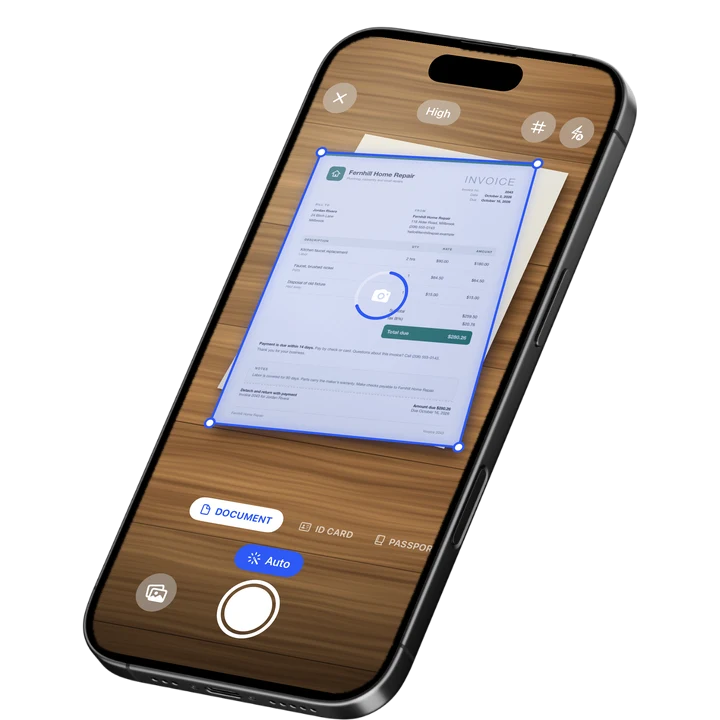
Over a trillion paper documents still sit in physical storage worldwide. Every one of them is a potential scan, and the difference between a flat image and a genuinely useful document is whether OCR runs at the moment of capture. Filewise applies text recognition on the phone the instant you scan, turning a receipt, contract, ID, or handwritten note into a multi-page PDF with searchable text in the app.
Most scanning apps skip the OCR step or put it behind a higher tier. Filewise includes text recognition by default. Scan, search, sign, and export, with Face ID to keep sensitive files locked.
Get Filewise and scan paper into PDFs with text that's genuinely searchable in the app on your iPhone.
Frequently Asked Questions
How many PDFs are created each year?
Over 290 billion new PDFs are created annually worldwide, growing at 12% year over year, according to Smallpdf. More than 2.5 trillion PDFs exist in total. Adobe Acrobat alone accounts for 400 billion PDF opens per year, making PDF by far the most widely used document format in the world.
What share of PDF views happen on mobile devices?
Sixty-three percent of PDF views now happen on smartphones and tablets, according to Smallpdf's 2025 data. iOS leads in North America and Western Europe, while Android accounts for 58% of mobile PDF actions globally. By contrast, 72% of PDF edits still take place on desktop, reflecting a read-on-phone, edit-on-computer workflow pattern.
What percentage of scanned PDFs are searchable?
Approximately 67% of scanned PDFs are searchable, meaning roughly one in three remains an unsearchable image-only file, according to Smallpdf. Less than 20% of all PDFs meet basic accessibility standards. OCR adoption has grown 45% since 2020, but many scanning apps still save documents as flat images without applying text recognition at capture.
How large is the PDF software market in 2026?
The global PDF software market is valued at $2.68 billion in 2026 and is projected to reach $7.13 billion by 2035 at an 11.47% compound annual growth rate, according to Global Growth Insights. The PDF editor software segment is growing faster, at 18.09% annually, reaching a projected $17.71 billion by 2033 per Business Research Insights.
🔒 Face ID lock | 📱 Built for iPhone